
Social Compass: Call for Papers from the SISR/ISSR 2013 Conference

The ISSR Editorial Board invites you to submit your paper presented in French or in English at the 32nd Conference in Turku, to be published in Social Compass 2015 (2).

Social Compass is a fully peer-review international journal that publishes original research and review articles on the sociology of religion, i.e. we don’t accept those articles that have been published in another journal or book and in another language.

Preparing your text, please pay attention to the following rules:

  1. Please, send one copy by email before November 15th, 2013 to the President of the Editorial Board, Véronique Altglas, School of Sociology, Social Policy and Social Work, Queen’s University Belfast, Belfast BT7 1NN, United Kingdom (v.altglas@qub.ac.uk).
  2.  In the first page, please write the title, your name and surname, your institutional affiliation, mail, address, telephone/fax numbers.
  3. Full-length articles should be no more than 6.000 words, all included, with a 150-word abstract (in English) and résumé (in French), 5 key words, and a 100-word biographical, tables and references. Please, send a text double spaces, Times 12. If your article includes tables, please prepare that in a separate file.
  4. For the references, please follow the rules of Social Compass (name+date).

Véronique Altglas
President of the Editorial Board
School of Sociology, Social Policy and Social Work,
Queen’s University Belfast,
Belfast BT7 1NN,
United Kingdom
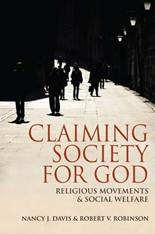
Book Announcement: “Claiming Society for God: Religious Movements and Social Welfare in Egypt, Israel, Italy, and the United States”

clip_image002Nancy Davis and Robert Robinson’s Claiming Society for God: Religious Movements and Social Welfare in Egypt, Israel, Italy, and the United States (Indiana University Press, 2012) has been awarded the gold medal in the Religion category of the Independent Publishers Book Awards, which recognize books by university and independent presses. The book also won the Scholarly Achievement Award of the North Central Sociological Association.

The book focuses on common strategies used by religiously orthodox (what some would call “fundamentalist”) movements around the world. Rather than using armed struggle or terrorism, as much of post-9/11 thinking suggests, these movements use a patient, under-the-radar strategy of taking over civil society.

Claiming Society for God tells the stories of the Muslim Brotherhood in Egypt, the Sephardi Torah Guardians or Shas in Israel, Comunione e Liberazione in Italy, and the Salvation Army in the United States, showing how these movements, grounded in a communitarian theology, are building massive grassroots networks of religiously based social service agencies, hospitals and clinics, rotating credit societies, schools, charitable organizations, worship centers, and businesses. These networks are already being called states within states, surrogate states, or parallel societies, and in Egypt have now brought the Muslim Brotherhood to control of parliament and the presidency.

This bottom-up, entrepreneurial strategy is aimed at nothing less than making religion the cornerstone of society.

The Facebook page for the book, which includes news stories on orthodox movements and study questions for the book is at www.facebook.com/ClaimingSocietyForGod.

Session List for the 2014 ISA World Congress (Research Committee 22: Sociology of Religion) – Upcoming Call for Papers

ISA World Congress – Yokohama 2014
Full RC22 Session List

Part 1: Special Sessions

1. Presidential Address: Facing an Unequal Adam Possamai, RC22 President
Post-Secular World

2. Presidential Invited Session: Religion, Organized by Adam Possamai
Nationalism, and Transnationalism

3. RC22 Business Meeting

Part 2: Open Sessions: please submit your paper proposals at the ISA website; links will be posted after 3 June at http://www.isa-sociology.org/congress2014 /rc/rc.php?n=RC22 Deadline: 30 September

TITLE ORGANIZER

4. Sociology of Religion in Africa: Challenges and Prospects

5. Uses of the Past: The Politics of Religion and Collective Memories

6. The Role of Religion in the Public Sphere

7. Religion as a Factor in the Composition and Decomposition of Ethnic Identities

8. Religious and Spiritual Capital: Reproducing, Overcoming or Going Beyond Inequality?

9. The Best of All Gods: Sites and Politics of Religious Diversity in Southern Europe

10. Religion and the Transition to Adulthood

11. Religious Diversity and Social Change in Contemporary East Asia

12. Welfare and Civil Society: The Role of Religion

13. Religion in the Era of Climate Entropy

14. Multiculturalism and Religion: Contemporary Challenges and Future Opportunities

15. (Non)Religion in Question: Ethics, Equality, and Justice

16. Religion, Immigration, & Health (Co-Sponsored by RC 15 (Medical Sociology) and RC 31 (Sociology of Immigration)

17. Roundtables on Religious Organizations
[SEE NOTE BELOW]

a. New Forms of Religious Organization

b. The Impact of Neoliberal Policies, Practices and Ideas on Religious Organizations

c. Facing Inequality from the Perspective of Islamic Organizations

Adogame, Afe

Burchardt, Marian & Koenig, Mattias

Furseth, Inger

Jevtik, Miroljub

Lombaard, Christo & Hämmerli. Maria

Mapril, José

Niemelä, Kati

Okuyama, Michiaki

Pettersson, Per

Rivas, Ver

Roose, Joshua

Schenk, Suzanne &
Schuh, Cora

Shapiro, Ephraim

Kern, Thomas & Pruisken, Insa

Martikainen, Tuomas

Rosenow-Williams, Kerstin &
Kortmann, Mattias

Part 3: Invited Sessions: these sessions are not open for papers; their participants have already been invited.

TITLE ORGANIZER

18. Locating Religion in Civilizational Analysis

19. Civil Rights and Religious Freedoms in a Secular World

20. Film: Haifa‘s Answer plus invited discussion

21. Religion and Countering Gender Inequality

22. Organized Conversations on Religious Research:
[SEE NOTE BELOW]

a. Lessons For Studying Religion In The African Diaspora: Charles H. Long & Ruth Simms Hamilton

b. The Sociology of Orthodoxy: Responses of Local Civilizations to the Challenges of a Globalizing World

Arjomand, Said & Tiryakian, Edward

Blancarte, Roberto

Cipriani, Roberto

Halafoff, Anna, Tomalin, Emma
& Caroline Starkey

Dodson, Jualynn

Podlesnaya, Maria

NOTE ABOUT “ROUNDTABLES”: We are allowed just 22 sessions, including the Business Meeting. We have therefore combined five sessions into “roundtable” sessions, which allow more than one session to take place at one time. WE HAVE NOT YET CHOSEN WHICH SESSIONS WILL BE ROUNDTABLES AND WHICH WILL HAVE FULL SESSIONS!!

The ISA required us to assign sessions to these slots, and we did so. THESE PRELIMINARY ASSIGNMENTS ARE NOT FINAL. We shall make the final assignments after all papers have been received. Our assignments will depend on several factors, none of which we can gauge now.

Grace Davie: The Sociology of Religion: A Critical Agenda (2nd edition)

The Sociology of Religion: A Critical Agenda Second Edition

Grace Davie
University of Exeter

February 2013
328 pages
SAGE Publications Ltd

Why is religion still important? Can we be fully modern and fully religious?  In this new edition, Davie follows up her discussion of the meaning of religion in modern society and considers how best to research and understand this relationship. Exploring the rapid movements within the sociology of religion today, this revised and updated book:

  • • Describes the origins of the sociology of religion
  • • Demystifies secularization as a process and a theory
  • • Relates religion to modern social theory
  • • Unpacks the meaning of religion in relation to modernity and globalization
  • • Grasps the methodological challenges in the field
  • • Provides a comparative perspective for religions in the west
  • • Introduces questions of minorities and margins
  • • Sets out a critical agenda for debate and research

The Sociology of Religion has already proved itself as one of the most important titles within the field; this edition will ensure that it remains an indispensable resource for students and researchers alike.

Instructors’ copies are available from SAGE: http://www.sagepub.com/books/Book234630?siteId=sage-us&prodTypes=any&q=davie+sociology+of+religion&fs=1

For 25% off the purchase price, use the following discount code and order online:  UK13SM007


Call for Papers for a Panel on Census and Surveys

Census and surveys: issues in religious self-identification

Panel at the 12th EASR conference at Liverpool Hope Organised by Dr Abby Day, Chair of SOCREL (Sociology of Religion study group, British Sociological Association) and Dr Bettina Schmidt, Honorary Secretary of the BASR (British Association for Study of Religions)

Self-identification on instruments such as surveys and censuses presents unique challenges and opportunities. The 2011 census for the UK revealed some interesting developments concerning the religious self-identification within the UK, particularly with the continuing increase of people who declare to have no religion. How does the utility of a census compare with, for example, larger surveys, from British Social Attitudes to the World Values Survey and how accurately can such data from any of those instruments represent changing religious landscapes? How does a faith in surveys and censuses manifest itself by discipline, and what impact does this have on our understanding of research methodology and outcomes? We invite to this panel papers discussing this and other issues concerning national census and survey design and data from the UK or any other country.

Please send abstracts (app. 150 words) to Dr Abby Day a.f.day@kent.ac.uk and Dr Bettina Schmidt b.schmidt@tsd.ac.uk by 1 May 2013.

CFP: IS THE POST-COLONIAL POST-SECULAR?

A Call for Papers
Conference in Syracuse, NY
September 20-21, 2013

Across the humanities, critical scholarship on the secular / secularism / secularization has recently ballooned. Scholars of history, anthropology, political theory, and religion have begun revisiting questions of enchantment and disenchantment, political theology, blasphemy, religious freedom, and much more. Charles Taylor’s A Secular Age in particular has garnered wide attention, but Taylor’s narrative focuses on the disenchantment of modern Christian Europe. Before and after A Secular Age, scholars have probed the boundaries of the secular beyond Christian Europe, and beyond the confines of intellectual history.

Some have asserted that the ideologies of secularism and colonialism are deeply intertwined. Others have asserted that post-colonial religiosity remains a symptom of colonial control of reason and affect. Still others have pointed to neo-liberalism as the shared basis of contemporary racial, religious, and post-colonial regimes.

We invite proposals that probe the question, “Is the Post-Colonial Post-Secular?” Projects may employ methods of history, literary criticism, theoretical reflection, ethnography, or cultural studies. We are interested in projects from a variety of regions and periods, for example contemporary Africa, the early U.S., or nineteenth century Haiti.

Please send 300 word abstracts, or questions, to: Owais Khan (mokhan01@syr.edu) and Vincent Lloyd (vwlloyd@syr.edu).

CFP: *Vision, Visuality and Visual Culture: Islamic Contexts and Publics*

*Call for Papers*
*AAA, Nov. 20-24 2013, Chicago*
*Vision, Visuality and Visual Culture: Islamic Contexts and Publics*
* *
This panel recuperates an understanding of visuality beyond Western histories by ethnographically exploring visual culture as a key site for thinking out the different trajectories of religion in contemporary Muslim societies. With Christianity usually posited as a* *”visual” religion and Islam as an “auditory”; one, most scholarly works looking at the intersections of visuality and religion have done so in a (Western) Christian context. In keeping with the AAA’s interdisciplinary emphasis this year, this panel puts into conversation anthropological studies of how the materiality of different media contributes to religious formations at particular historical moments with the interest of other scholars of visual culture in everyday, socially-grounded practices of seeing. We hope that attending more closely to visual fields in Muslim societies will contribute theoretically to long-standing disciplinary concerns with ritual, personhood, performance and the sacred.

What modes of (not) seeing are privileged or denounced within historically authoritative Islamic frames? How are different notions of visuality negotiated and/or contested in the age of rapid transnational television imports and exports? What do jurisprudential and popular debates over the production of dramatic serials visually depicting Qur’anic prophets tell us about the politics and ethics of sight? What visual analogies and metaphors do Islamic preachers and activists draw upon to connect with their imagined audiences? What new scopic regimes arise at the interface of new media technologies and Islamic exhortatory traditions? How is the faculty of seeing a site of ethical cultivation, affective pleasure or sensory excess? We invite papers addressing these questions through ethnographies and analyses of the production, circulation, consumption and framing of the
visual in Muslim societies.

Please submit abstracts of no more than 250 words and CVs to Yasmin Moll (yasmin.moll@nyu.edu Yasmin.moll@nyu.edu>) and Wazhmah Osman (wazhmah@gmail.com) by March 12.

Call for Papers – "International Conference on Education, Culture and Identity" (ICECI 2013).

The International Conference on Education, Culture and Identity (ICECI 2013) is organised by the International University of Sarajevo in partnership with Deakin University, Australia and Erciyes University, Turkey. The conference will be held at the  International University of Sarajevo, Bosnia and Herzegovina on 6-8 July 2013. For more information please visit the conference website: www.ius.edu.ba/iceci

Abstracts must be submitted online via the conference website:
www.ius.edu.ba/iceci

Conference Deadlines:
Submission of Abstracts April 1, 2013
Notification of Abstract Acceptance April 19, 2013
Registration Ends May 17, 2013
Conference Date July 6-8, 2013

Contact information:
Gulsen Devre +387 33 957 116
iceci@ius.edu.ba

Call for Papers: Routes and Rites to the City: Temporal and Spatial Diversity in Johannesburg’s Migrant Religions and Rituals

Call for Contributions

The proposed anthropological project — to be completed between March 2013 and June 2014 — aims to explore both the temporal and spatial diversity of migrant religious,divination and death rituals in inner-city and Southern Johannesburg. It will seek to explore how this diversity develops as a response to both the spiritual and material insecurities of experiences of migration. The interest in migration conceived broadly — not a bureaucratic category – but aims to explore experiences of mobility, dislocation and distance from familial and ancestral ‘homes’. Hence, it encompasses both South African nationals and non-nationals.

We aim here to outline the temporal and spatial diversity of these rituals of different urban spaces which churches occupy (the veld, factories, reclaimed churches and synagogues …) and both the economic and symbolic reasons for this diversity. In this analysis we will also conduct historical research into the uses of these urban spaces and the overlay of different temporal and spatial patterns of migration. We wish to delve into processes of sacralization and desacralization of the urban landscape as it results from disputed access to the urban space and is associated with mobility and migration historically and in its present formations.

The book will cover, among other religions and rituals: African Initiated Churches, Pentecostal, Apostolic, Catholic and Methodist churches – but aims to extend beyond a focus on Christianity. In particular we are looking for contributions on ‘traditional’ healing’ and indigenous African religions, Chinese religions, and Islam. The project will focus around Zone F and Rosettinville, though other areas will be considered.

The outputs of the project will be a book to be edited by Dr Matthew Wilhelm-Solomon (Matthew@migration.org.za) and Dr Lorena Nunez (Lorena.Nunezcarrasco@wits.ac.za ), a multi-media platform, a public symposium/workshop and an exhibition.

Participants would be expected to attend a bi-monthly discussion and reading group, to produce materials for online use and to produce a draft chapter by November 2012 and final chapter for presentation in a workshop/exhibition in February 2014, after which the final manuscript will be edited.

Technological support and limited research funding is available which will be allocated on a needs assessment. Submissions based on existing research will also be considered.

Please submit proposals with abstract, a CV and a sample of writing (preferably an existing publication) and proposed research costs (please note only research costs and not salaries or time will be paid for) by Friday March 8. Please send proposals via email to Peter Kankonde: Kankondepter@gmail.com,  cc’d to Dr Wilhelm-Solomon and Dr Nunez.