Interreligious Dialogue and Religious Syncretism

Call for Papers
International interdisciplinary scientific conference Interreligious Dialogue and Religious Syncretism
May 3-4, 2013
Kaunas, Lithuania

From the earliest times, encounters between people of different societies resulted in adoption of non-native religious customs, beliefs, practices, and concepts. Successful adoption of foreign customs and beliefs allowed some religions to spread so widely that today they are considered “the great world religions”. Today in Western society multiple religions coexist. There are many ways in which different religious traditions interact. They oppose or assimilate each other. They also enrich each other with new insights and cultural expressions. The contemporary situation of “religious market” and spread of modern technologies create many opportunities not only to know better the existing religions but also to create one’s own “private religion” by mixing various elements of different religious traditions.
This conference is the 4th one dedicated to the research of religious experience, tradition, and religious consciousness. Main questions of this conference are: What do we mean by “syncretism”? Where is the dividing line between interreligious dialogue and religious syncretism? Is the interreligious dialogue possible without absorbing some features of the other side? Is it possible for religious tradition to stay pure and without additives for longer time? What influence do religious experiences and practices have (if they do) on the merger of religious traditions?

The Conference organizers invite scholars of different disciplines to address these and similar questions and welcome papers in line with the Conference theme, particularly in relation to the following subthemes:
• Problems of defining syncretism
• “Good” and “bad” syncretic processes
• “Eastern” and “Western” syncretism
• Inculturation of Christianity
• Missionary work in the modern societies
• Religious experience as an ecumenical phenomenon
• Clash of religions as the form of interreligious dialogue
• Psychological, social, anthropological, artistic aspects of interreligious communication

Please submit an abstract of your paper of 250-300 words, together with your name, position, and institutional affiliation to religio@ktf.vdu.lt by February 15, 2013. The abstract should be sent as an email attachment in Microsoft Word format.

Registration fee is 30 € (EUR). Unfortunately, there are no funds available at the time to cover the accommodation- or travel-expenses.

Selected extended papers from the conference will be invited to appear in the scientific journal ‘SOTER’ published by the Faculty of Catholic Theology at Vytautas Magnus University. The Journal is reviewed in the international databases: CEEOL, The Philosopher’s Index, eLABa, DOAJ.

Organizing institute: Vytautas Magnus University (Department of Philosophy, Faculty of Catholic Theology).
Venue: Vytautas Magnus University, Kaunas, Lithuania Conference languages: English, Lithuanian.
Submission of proposals – February 15, 2013 Notification of acceptance – February 27, 2013

Organizing committee: Assoc. prof. dr. Agnė Budriūnaitė (chair, VMU, Dep. of Philosophy), prof. habil. dr. Alfonsas Motuzas (VMU, Faculty of Catholic Theology), prof. dr. Eugenijus Danilevičius (VMU, Faculty of Catholic Theology), assoc. prof. dr. Živilė Advilonienė (VMU, Faculty of Catholic Theology), assoc. prof. dr. Povilas Aleksandravičius (MRU, Dep. of Philosophy), assoc. prof. dr. Benas Ulevičius (VMU, Faculty of Catholic Theology), assoc. prof. dr. Jurga Jonutytė (VMU, Faculty of Political Science and Diplomacy), dr. Aušra Kairaitytė (VMU, Faculty of Humanities), assist. prof. dr. Valdas Mackela (VMU, Faculty of Catholic Theology).
‘Risk and Rapture: Apocalyptic Imagination in Late Modernity’ University of Chester Sept 2013

CALL FOR PAPERS

Risk and Rapture: Apocalyptic Imagination in Late Modernity
Centre for Faiths and Public Policy, University of Chester
Wednesday 11th September 2013
Keynote Speaker: Professor Scott Lash (Goldsmiths College, University of London)

Apocalypse captivates the human imagination. Once synonymous with ‘end of the world’ scenarios and confined largely to the religious, the term is part of vernacular language in the West and is used to describe a myriad of events from the fiscal difficulties of the Eurozone to nuclear war, from environmental disaster to the dangers of digital technology.
The advancement of science and technology has assisted in expediting anxiety with regard to apocalyptic catastrophe because such ‘progress’ has produced unforeseen hazards and risks. Critical theories of risk have been developed that harness and organise responses to scientific developments in an attempt to provide solutions to possible catastrophe. It is suggested that in order to prevent global catastrophe, modern society must be reflexive. Moreover, the advent of such hazards has served as a recruiting sergeant for fundamentalist religious groups who have clear and explicit eschatologies. Rather than viewing possible risks and hazards as by-products of late modernity-‘signs of the times’, they are re-interpreted as ‘signs of the end times’. Consequently, one strand that runs through the above is the political implications of apocalyptic ideology and theories of risk. Whether this is the focus some Christian dispensationalist groups put on the role of the state of Israel in the Middle East, or the so-called catastrophic acceleration of global-warming, decisions based on interpretations of these inevitably have political ramifications.
The purpose of this inter-disciplinary conference is to investigate and evaluate some of the variety of apocalyptic discourse that exists in contemporary popular western culture along with critical theories of risk.

Papers are invited that explore both the secular and religio-political dimensions of apocalyptic language in contemporary society and include, but not restricted to, the following themes:
* Secular interpretations of apocalypse;
* Religio-political apocalyptic discourse;
* Critical theories that seek solutions to contemporary notions of risk;
* Correlations between critical theories of risk and apocalyptic ideology;
* The growth of fundamentalisms as a reaction to risk culture(s).

Proposals for short papers are invited on any aspects or themes related to the above. Papers will be 20 minutes in length with an additional 10 minutes discussion. Applications to submit a paper should include:
* Proposer’s name and affiliation;
* Title of the paper;
* 250-word abstract;
* Details of any audio-visual equipment you will need to deliver your paper.
Short paper proposals should be submitted to Riskraptureconf@chester.ac.uk by no later than 4pm on Friday 6th April 2013. Conference costs: £50 (£25 unwaged and students) inclusive of lunch and refreshments. Conference registration will open in due course.

Western Esotericism and Health

ESSWE4 Gothenburg 26-29 June 2013
Western Esotericism and Health
26-29 June 2013, University of Gothenburg, Sweden

http://www.esswe.org/#p/esswe-4-2013.html

Issues relating to health (understood in a broad sense) can be seen as an intrinsic part of the field of esotericism, but surprisingly little attention has been given to how health is understood and construed in esoteric discourses. The conference is thus as an attempt to fill an important lacuna in the study of Western esotericism. Suggested topics include (but are not limited to), esoteric notions and discourses on health, sexuality and well-being, “occult” causes for disease, “occult medicine”, notions of therapeutic benefits of magic and meditation, alchemical approaches to health, alternative forms of medicine, etc.

Keynote lecturers include:
Catherine L. Albanese (University of California) Peter Forshaw (University of Amsterdam) James R. Lewis (Tromsø University) Mark Sedgwick (Aarhus University) Andrew Weeks (Illinois State University) Alison Winter (University of Chicago)

Papers are invited in English. Proposals for 20 minutes’ papers (title and short abstract of approximately 250 words) should be sent to Henrik Bogdan (henrik.bogdan@religion.gu.se), with your name and academic affiliation, by January 15, 2013.Conference Chairman: Henrik Bogdan (University of Gothenburg)

Conference Committee: Egil Asprem, Henrik Bogdan, Olav Hammer, Kennet Granholm, Asbjørn Dyrendal and Jesper Aa. Petersen

Critical Analysis of Religious Diversity Network: Theory and Methodology

Critical Analysis of Religious Diversity Network: Theory and Methodology

International Workshop: 24-25 May 2013
Organised by the Centre for Contemporary Religion, Aarhus University, funded by the Danish Research Council.

Applications are invited for a limited number of funded places (covering travel, food, and accommodation) to attend the inaugural meeting of the CARD Network. The network will hold its first meeting, at Aarhus University, Denmark on May 24-25, 2013. For this meeting, we invite international scholars to explore the theme of how to study religious diversity. The network will critically analyze what is currently a disparate field of scholarship to explore the consequences of how scholars are constructing the social realities of religious diversity in the world. Initially, the network aims to collectively analyze the context dependent methods that scholars are currently using to study diversity. We then aim to further refine and develop that preliminary analysis to inquire if there are general methods of studying diversity which might be applicable from nation to nation. Finally, the network intends to use this practical analysis to develop theoretical frameworks for considering how the methods used to discuss religious diversity have shaped the way religion is understood by both governments and the academic community. The project’s ultimate goal is to attain a clearer understanding of how religion is conceptualised, defined and policed by States and the scholars who study religious diversity within those nations.

The network will be led by Lene Kühle, Aarhus University in association with Jørn Borup, Aarhus University, William Hoverd, Victoria University of Wellington, and Tim Jensen, University of Southern Denmark.

Invitees will present a 20min talk and be prepared to engage in a critical discussion of their work. In addition, we want our participants to think critically about the assumptions that have been made about religious diversity in their research methods/context. We include our working questions below:

Questions we want to ask
1. Does your research use the term religious diversity, pluralism or both terms? Do you see the terms as distinct from each other?
2. What methods are researchers currently using to study religious diversity? Are they using quantitative data, qualitative data, census data, or micro, macro, comparisons?
3. What are scholars finding to be the strengths and weaknesses of these methods for this research?
4. What artificial limitations and relationships have researchers assumed when using broad categories to define religious groups such as Buddhist, Christian and Muslim?
5. How have researchers treated individuals who profess multiple religious affiliations and those who conflate their religion with their national or ethnic identity?
6. Is your research constrained by human rights discourses and law?
7. How is unbelief/non religion being assessed?
8. How have numerically small religious groups been treated by researchers?
9. Are researchers finding that new categories and/or definitions of religious belief are necessary?
10. How have scholars addressed the relationship between the nation state and religious diversity in their context?

We ask that you state your interest in attending the CARD network workshop by sending us a 250 word abstract by January 14th 2013. Please also include your name, address, and institutional affiliation.
CARD has been invited to organize a session on religion and cultural diversity at a parallel conference (“Matchpoints Seminar”) taking place May 23-25 in Aarhus (where invited speakers include Will Kymlicka and Robert Putnam). Please indicate it if you are interested in presenting at this session also (on May 23). More information is to be found at http://matchpoints.au.dk/ Please send your statement of interest to: Dr Jørn Borup, JB@teo.au.dk by January 14th 2013.

Changing Religious Movements in a Changing World

The 2013 International Conference

CHANGING RELIGIOUS MOVEMENTS IN A CHANGING WORLD
Dalarna University, Falun, Sweden
June 21-24, 2013

Term for submitting paper proposals expiring soon
Due to various requests connected to the season’s holidays, we are pushing the term for submitting paper and session proposals for CESNUR 2013 in Sweden to January 20, 2013.
See the call for papers at http://www.cesnur.org/2013/swe-cfp.htm.
The location and program are very exciting and we will urge you to submit your proposals on time.
Happy New Year
CESNUR

Religion and Society In Central and Eastern Europe

VOL 5, NO 1 (2012) of Religion and Society In Central and Eastern Europe is now available at http://www.rascee.net/index.php/rascee/issue/view/5/showToc

TABLE OF CONTENTS

EDITORIAL
Editorial

ARTICLES

Studying Religion and Power: Conceptual and Methodological Challenges
Pål Repstad

Religion in Central European Societies: Its Social Role and People’s Expectations
Branko Ančić, Siniša Zrinščak

What about Our Rights? The State and Minority Religious Communities in Croatia: A Case Study
Ankica Marinović, Dinka Marinović Jerolimov

Extremist Manipulations of Apocalyptic Fears: A Case Study of de-Christianisation and Islamisation Discourses on the Romanian New Right Blog
Adela Fofiu

REVIEWS

András Máté-Tóth and Cosima Rughiniş (eds.) Spaces and Borders: Current Research on Religion in Central and Eastern Europe Berlin/Boston: De Gruyter,
James T. Richardson

Gert Pickel and Kornelia Sammet (eds.) Transformations of Religiosity. Religion and Religiosity in Eastern Europe 1989 – 2010 Wiesbaden: Springer VS, 2012. 216 pages. ISBN: 978-3-531-17540-9. € 34.95 (paperback)
Peter Török

Lavinia Stan and Lucian Turcescu Church, State, and Democracy in Expanding Europe Oxford: Oxford University Press, 2011. 287 pages. ISBN: 978-0-19-533710-5. US$ 65 (hardback)
Monica Grigore

Milda Ališauskienė and Ingo W. Schröder (eds.) Religious Diversity in Post-Soviet Society. Ethnographies of Catholic Hegemony and the New Pluralism in Lithuania Farnham/Burlington: Ashgate, 2012. 226 pages. ISBN: 978-1-4094-0912-0. £45.00 (hardback)
Smoczynski Rafal

Mapping Religion and Spirituality in a Postsecular World

Giuseppe Giordan and Enzo Pace (eds), Mapping Religion and Spirituality in a Postsecular World, Brill, 2012.

Individualization of believing and the logic of pluralism today inevitably bring a redefinition of the role of religion in the lives of individuals as well as societies themselves. New concepts and new theories are necessary to try to describe and understand how such processes work: this is without doubt the most problematic and intriguing aspect of the processes of change that characterize our era. This is a difficulty that makes us use only partially, and often with much caution, words, concepts and theories that until not long ago had a convincing heuristic and explanatory power and were, at least apparently, indisputable. Once it is established that under the sacred vaults of religion nothing is created and nothing is destroyed, but everything is preserved and transformed, what are the connections that are now being established with the sacred in society? The concepts “spirituality” and “post-secular” give important insights into the new religious landscape.

This volume will be of interest both to those interested in the responses of traditional religions to conditions of postmodernity and to those seeking to interpret the postmodern “experience” in religious terms.

Giuseppe Giordan is Senior Lecturer in Sociology at the University of Padua. From 2007 he has served as Secretary of the Sociology of Religion Section of the Italian Sociological Association, and from 2009 as General Secretary of the International Society for the Sociology of Religion (ISSR/SISR). With Enzo Pace and Luigi Berzano he edits the Annual Review of the Sociology of Religion, also published by Brill.

Enzo Pace, Professor of Sociology and Sociology of Religion at the Faculty of Political Sciences of the University of Padua, is the Director of the Department of Sociology and of the Interdepartmental Center on Intercultural Studies of the University of Padua. He is also Past-President of the International Society for the Sociology (ISSR/SISR) and a Directeur d’Études at ÉHÉSS in Paris.

Contributors include: Anhony J. Blasi, Yong Chen, Monica Chilese, Emanuela Contiero, Elisabetta di Giovanni, Anat Feldman, Isabella Jonveaux, Ruth Illman, Liselotte Frisk, Fatma Sundal, and Sophie-Hélène Trigeaud

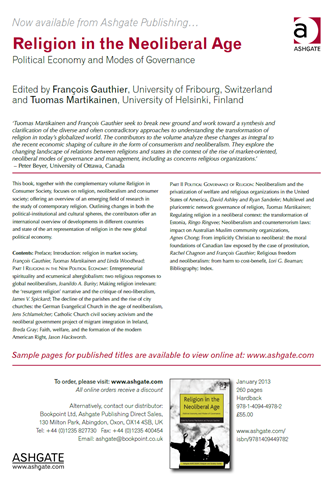
Religion in the Neoliberal Age: Political Economy and Modes of Governance

Religion in the Neoliberal Age Political Economy and Modes of Governance
Edited by François Gauthier, University of Fribourg, Switzerland and Tuomas Martikainen, University of Helsinki, Finland Ashgate 2013
http://www.ashgate.com/isbn/9781409449782

This book, together with the complementary volume Religion in Consumer Society, focuses on religion, neoliberalism and consumer society; offering an overview of an emerging field of research in the study of contemporary religion. Outlining changes in both the political-institutional and cultural spheres, the contributors offer an international overview of developments in different countries and state of the art representation of religion in the new global political economy.

‘Tuomas Martikainen and François Gauthier seek to break new ground and work toward a synthesis and clarification of the diverse and often contradictory approaches to understanding the transformation of religion in today’s globalized world. The contributors to the volume analyze these changes as integral to the recent economic shaping of culture in the form of consumerism and neoliberalism. They explore the changing landscape of relations between religions and states in the context of the rise of market-oriented, neoliberal modes of governance and management, including as concerns religious organizations.’- Peter Beyer, University of Ottawa, Canada

Contents
Introduction: Religion in Market Society François Gauthier, Tuomas Martikainen and Linda Woodhead
PART I Religions in the New Political Economy
1 Entrepreneurial Spirituality and Ecumenical Alterglobalism: Two Religious Responses to Global Neoliberalism Joanildo A. Burity
2 Making Religion Irrelevant: The ‘Resurgent Religion’ Narrative and the Critique of Neoliberalism James V. Spickard
3 The Decline of the Parishes and the Rise of City Churches: The German Evangelical Church in the Age of Neoliberalism Jens Schlamelcher
4 Catholic Church Civil Society Activism and the Neoliberal Governmental Project of Migrant Integration in Ireland Breda Gray
5 Faith, Welfare and the Formation of the Modern American Right Jason Hackworth
PART II Political Governance of Religion
6 Neoliberalism and the Privatization of Welfare and Religious Organizations in the United States of America David Ashley and Ryan Sandefer
7 Multilevel and Pluricentric Network Governance of Religion Tuomas Martikainen
8 Regulating Religion in a Neoliberal Context:The Transformation of Estonia Ringo Ringvee
9 Neoliberalism and Counterterrorism Laws: Impact on Australian Muslim Community Organizations Agnes Chong
10 From Implicitly Christian to Neoliberal: The Moral Foundations of Canadian Law Exposed by the Case of Prostitution Rachel Chagnon and François Gauthier
11 Religious Freedom and Neoliberalism: From Harm to Cost-benefit Lori G. Beaman

image

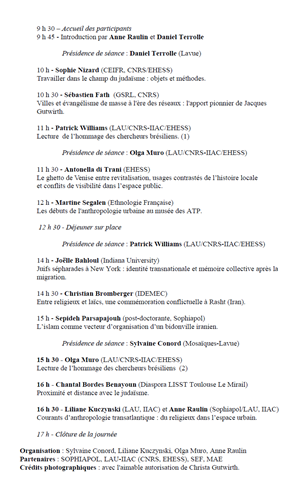
Journée Hommage J. GUTWIRTH, Nanterre, 11-01-2013

Une journée d’études rendra hommage à Jacques Gutwirth, qui fut de longues années membre de l’AFSR.
« Croiser anthropologies urbaine et religieuse : hommage à Jacques Gutwirth »

Lieu : Université Paris-Ouest Nanterre La Défense
11 janvier 2013 à la Maison de l’Archéologie et de l’Ethnologie, Salle 308
21 allée de l’Université
92001 Nanterre
Station RER A : Nanterre-Université
Bien cordialement,– Louis Hourmant, Secrétaire général de l’AFSR

image image

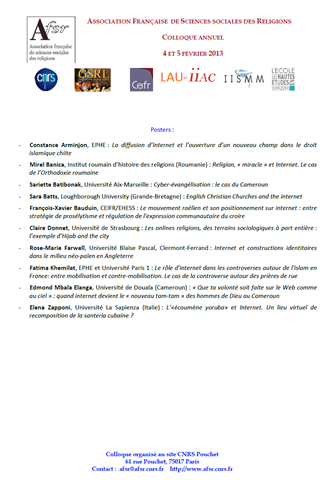
Programme colloque AFSR 4-5/02/2013 "Le religieux sur internet"

Voici le programme du colloque organisé par l’Association française de sciences sociales des religions (AFSR) à Paris (CNRS-Site Pouchet, 59 rue Pouchet, Paris 17e) les 4 et 5 février 2013 sur le thème :
LE RELIGIEUX SUR INTERNET.

N’hésitez pas à diffuser cette information et ce programme.
Bien cordialement,
Louis Hourmant,Secrétaire général de l’AFSR

image 

image